On Monday the 16th of Feb., Professor Andrew Hugill will take you on a tour of music modernism, postmodernism, structuralism, minimalism with a culmination in the digital culture.
Instead of preparing reading for the next lecture I've asked that you each write a blog response to Prof. Hugill's lecture. Some things to include:
Title: Lecture 6: Music and Digital Culture, Name
Summary of the lecture and how it fits in with the theories/ideas we've been looking at
An image that you have taken during the lecture, either of the group working or perhaps of Prof. Hugill speaking
A question to Prof. Hugill. Perhaps after the lecture you have a question about what he said, or maybe you'd like more examples of music to listen to, or even a clearer link of how musical interpretations/theory align with what we've already covered
Do take a look at Professor Hugill's recent book, The Digital Musician. It's available on Amazon and some parts are readable via google.
Today we reviewed Structuralism and spoke a little bit about how Derrida and Poststructuralism fit within the time-line of literary theories.
We noted that (largely) for Structuralism and Formalism that the structure of language produces reality and that the meaning of a text (be it a novel or musical piece or artwork) is (usually) derived from the elements which constitute it (grammar or line and colour and texture) rather than the context etc...
The critical thing about this course is the reading which follows the train of thought of the module. Going back to the name of the module (digital cultures) what happens when you put the two words together. What is culture - how might one define it?
Andy: Accumulated knowledge but not necessary everything that gets accumulated in history, because not everything makes it into being culture.
Andrew: Whose knowledge?
Andy: collective knowledge...
Andrew: Where is this knowledge and how do you access it?
Andy: books, a collective subconscious of things remembered
Andrew: so the surrounding culture shapes our identity, some kind of context for everything. This was one of the major conclusions from our first lecture, that everything has a context: people and artifacts.
The other word is digital?
Andy: A bland definition as compared to analogue, whereby digital works by a binary signal, on or off, 1 or 0.
Andrew: So a system of encoding? How do the 1s and 0s operate?
Task: get a simple definition of digital
Whereas culture is all about context, digital numbers don't really have a context.
Wittgenstein: Believed in scientific fact but is there such a thing as scientific fact? (Andy's question). See Richard Feynman.
"We can't define anything precisely. If we attempt to, we get into that paralysis of thought that comes to philosophers… one saying to the other: "you don't know what you are talking about!". The second one says: "what do you mean by talking? What do you mean by you? What do you mean by know?" Volume I, 8-2
Think syllogism: "a deductive scheme of a formal argument consisting of a major and a minor premise and a conclusion (as in “every virtue is laudable; kindness is a virtue; therefore kindness is laudable."
Read Beckett's Murphy as there is a lot about the Modernist outlook. As Joyce said, Finnegan's Wake is not about something it is the something" - overall aim of the Modernist Project. Inspiration for musicians (John Cage, Barry Truax his riverrun, Roger Marsh).
Joyce, Vladimir Lenin and Tristan Tzara all in Zurich in 1917.
Barthes:
"ACCORDING TO ROLAND BARTHES, all narratives share structural features that each narrative weaves together in different ways. Despite the differences between individual narratives, any narrative employs a limited number of organizational structures (specifically, five of them) that affect our reading of texts. Rather than see this situation as limiting, however, Barthes argues that we should take this plurality of codes as an invitation to read a text in such a way as to bring out its multiple meanings and connotations. Rather than read a text for its linear plot (this happens, then this, then this), rather than be constrained by either genre or even temporal progression, Barthes argues for what he terms a "writerly" rather than a "readerly" approach to texts. According to Barthes, "the writerly text is ourselves writing, before the infinite play of the world (the world as function) is traversed, intersected, stopped, plasticized by some singular system (Ideology, Genus, Criticism) which reduces the plurality of entrances, the opening of networks, the infinity of languages" (5). This closing of the text happens as you read, as you make decisions about a work's genre and its ideological beliefs; however, when you analyze any one sentence of a work closely, it is possible to illustrate just how impacted with meaning (and possibility) any one sentence really is."
What is a myth? An anonymous story that attempts to explain a world view.
Derrida: does the author have any importance to a story?
"'there is no outside-the-text' signifies that one never accedes to a text without some relation to its contextual opening and that a context is not made up only of what is so trivially called a text, that is, the words of a book or the more or less biodegradable paper document in a library. If one does not understand this initial transformation of the concepts of text ...[and] ... context, one understands nothing about nothing of .... deconstruction ..."
"all those boundaries that form the running border of what used to be called a text, of what we once thought this word could identify, i.e. the supposed end and beginning of a work, the unity of a corpus, the title, the margins, the signatures, the referential realm outside the frame, and so forth. What has happened ... is a sort of overrun that spoils all these boundaries and divisions and forces us to extend the accredited concept, the dominant notion of a 'text' ... that is no longer a finished corpus of writing, some content enclosed in a book or its margins, but a differential network, a fabric of traces referring endlessly to something other than itself, to other differential traces."
TASK: Read!
Question: What is the culture of Wikipedia?
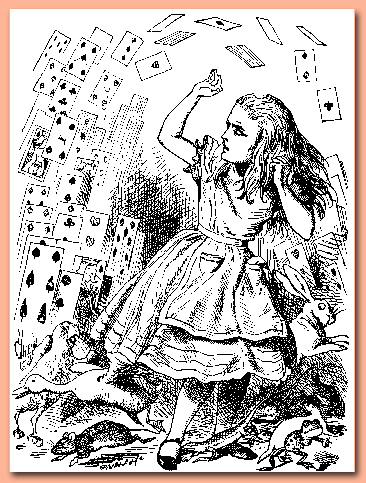
For interest: Read Alice in Wonderland and/or The Annotated Alice: The Definitive Edition ed. Martin Gardner. For more on Alice see here. In a way, Alice is a story that has achieved that *mythical* status - it has woven together mathematical principles, cultural ideas etc..."
What is digital culture? - Recap? (nb live blogged!)
We are looking beyond the IOCT to address the idea of forming a critical framework, judgements and to theorise one's own artistic work. That way we can demonstrate an understanding of what we're doing. When you come to do your final projects this kind of critical thinking will stand you in good stead.
Languages of New Media
Paul explains that there is always an element of interactivity with digital media. It's not necessarily true that there is a huge change when one moves on to a computer but there are degrees of interactivity.
Andy: well, everything is interactive.
Paul: sometimes it isn't important is someone interacts with something, what was important was the process...doesn't need an interactive purpose.
Jess: but as artist/creator you were interacting in the process of creation.
Andrew: so when artists create interactive installations is that a meaningless phrase or is there a point being made?
Paul: thinks this is about the intention rather than the meaning behind it. With all works of art and all systems of representation the user is required to fill in gaps in system (Manovich).
Andy: thinks interactive is being used to define degrees of control that the audience has
Andrew: so an interactive installation seems to imply that the audience has more control than a *usual* installation.
Jess: so does interactivity mean (for Paul) that the user can *change* the content
Paul: yes, to change the way it is deployed and navigated.
Andrew: If I build a pool, fill it and swim in it, how is that *experience* different from swimming in another pool?
Andy: to really originate something you must be the first person to make it (i.e. the wheel). But, innovation as a pure form and then innovation with constraints.
Paul: reminds us of Pierre Mendard and the context of the work
Andrew: If you have a sock and it gets a whole and you darn it and you keep darning it then over time you replace the thread...is it still the same sock? *infinite regress*
Solipsism: if a tree falls in the forest does it make a noise? This is the problem with postmodernism, the only way anything can be said to have a meaningful is if we all share that social reality but with postmodernism there is no social reality.
"... the sane, having at their disposal all the most deadly weapons of the postwar recovery; on the other, a seedy solipsist and fourpence. ..."
Murphy 82.
Paul: with musicians, though the music might not have been written by the performer it takes on a new meaning/context
Jess: thus gains some originality
Paul on Manovich: not only creating the things you want to create but that everyone who sees your work understands what you're trying to create.
Andrew: "intuition": discuss!
Andy: something you know without being told, people talking about interface design and what's intuitive for some people is not intuitive for others
Andrew: are there levels of intuition that exist apriori? (how birds know to migrate) With regard to elephant coming out of the wall, neuroscience is the most fertile ground right now for examining these things. There may be some kind of way of understanding what people know or want in a given situation.
Andy: But, if you put enough people in a room with a button and ask them what will happen one is BOUND to think an elephant will appear.
Andrew: how do we know intuition is intuition?
Andy: so there are cultural assumptions on what is intuitive.
Back to: Le Corbusier:
"If I hold up a primary cubic form, I release in each individual the same primary sensation of the cube; but if Iplace some black geometric spots on the cube, I immediately release in a civilised man an idea of dice to play with, and a whole series of associations which would follow. A Papuan would see only an ornament."
(1920)
What Le Corbusier was interested in were universal truths. There was a strong element of idealism here. And of course the consequences of this we see in Leicester with the *design* of the buildings.
But there is some interesting 60s design in Leicester:
""The Engineering Building comprises large ground-level workshops (heavy machinery), covering most of the available site, and a vertical ensemble consisting of office and laboratory towers, lecture theaters and lift and staircase shafts."
Photo, exterior overview · Engineering Building · Leicester University, Leicester, England
Andrew: So, is it possible to have pastiche that isn't hideous?
(this question stumped us for a while)
Andrew: Culturally we've been through a shift. Pastiche had been used as a valued way of people learning how to create art (music and painting). The idea was to be as close to the model as possible = good training. But, with Modernist aesthetic pastiche become loathesome and unoriginal. Replicating the trodden path. But now the keywords are innovation, creation, and originality. Emphasis on developing one's own voice.
Jess: Pastiche now is about challenging and questioning previous contexts.
Think of "The Band" and their song that incorporates a brass band segment.
Implies the user/reader has a more elevated status as they can understand this questioning/challenge.
Andrew: postmodern thought is largely affiliated with technology. The main point here seems to be "what is original, what is pastiche, what is contextualising." clearly very important for postmodern theory (think Lyotard).
Paul: Interesting point that knowledge loses its "use-value" so knowledge is tied to commercialisation. So, in web 2.0 are things that are supposed to be of use-value are actually about commerce?
"The nature of knowledge cannot survive unchanged within this context of general transformation. It can fit into the new channels, and become operational, only if learning is translated into quantities of information. We can predict that anything in the constituted body of knowledge that is not translatable in this way will be abandoned and that the direction of new research will be dictated by the possibility of its eventual results being translatable into computer language. The 'producers' and users of knowledge must now, and will have to, possess the means of translating into these languages whatever they want to invent or learn.”
Jess: but it seems that lyotard is combining two knowledges, that of creation and that of dissemination (form and content)
Paul: Going back to the idea of exchange having value but now it's the content that has value.
Andy: In open source the idea is that information has a value but not necessarily a monetary value. It has a value when shared not on it's own.
Andrew: Howard Rheingold sees the commons of information being privatised.
Jess: so commodified knowledge can live alongside knowledge for knowledge's sake.
Paul: maybe the future is downloadable music where people get the info as well as the experience
Andrew: voluntary contributions (Radiohead) is not the future. People are prepared to pay what they think is fair.
Andy: having music freely available is more like a promotional tack rather than a way of making money.
Andrew: So the live gig is the privileged commodity.
Andrew: What is postmodernism?
"plagiarism by anticipation"
Student Presentations on "Everything is Mediated"
Andy:
Paul: "Everything is Mediated"
Reading for Next Week:
Barthes, S/Z, A Barthes reader / edited, and with an introduction, by Susan Sontag A Derrida reader : between the blinds / edited, with an introduction and notes, by Peggy Kamuf.
(nb our discussion on Barthes and Wittgenstein was in the context of digital culture)
"... ce qui m'a toujours préoccupé [...] c'est le problème de la signification des objets culturels."
~Barthes, Mythologies 64
"Dans la vie quotidienne, j'éprouve pour tout ce que je vois et entends une sorte de curiosité, presque d'affectivité intellectuelle qui est de l'ordre du romanesque."
~Barthes, Mythologies 192
Like Barthes, we're interested in exploring and questioning the perceived *naturalness* or *objectivity* of culture (its objects and codes). We talked about Barthes view (in "Operation Margarine") of French bourgeois culture. Interpriting an ad for margarine Barthes finds negatives or problems associated with a product (like margarine) are raised in order for its benefits to be revered which then outweigh any cons. Barthes explains that this technique is mirrored in discourses of religion, capitalism, and war. To put it simply, drawbacks are noted only as a way of further demonstrating the crucial significance the object or discourse has for culture.
"The episode always begins with a cry of indignation against margarine: 'A mousse? Made with margarine? Unthinkable!' 'Margarine? Your uncle will be furious!' And then one's eyes are opened, one's conscience becomes more pliable, and margarine is a delicious food, tasty, digestible, economical, useful in all circumstances. The moral at the end is well known: 'Here you are, rid of a prejudice which cost you dearly!"
Here we debated what the word "world" means and whether there exists a *universal* understanding of "world" and does the term world include what lies outside of our perceptions?
For Wittgenstein a picture (any picture?) is a model of reality because the objects in the image relate to each other in the same way that objects in the world relate to each other. If the relations do not correspond, then the picture is not of something in the world. (But this can still be considered reality because the world includes the "non-existence" of things).
“Given that every object must occur in some state of affairs or other (2.0121), we know that given all states of affairs, all objects are given as well. But we have already seen that given the totality of objects, all possible states of affairs are given (2.0124). In other words, given all existing states of affairs, we can construct, by way of the objects they contain, all possible states of affairs — both those that exist and those that do not exist. It is in this way that the structure of reality is implicated in the structure of the world. For quite trivial reasons, the structure of the world is implicated in the structure of reality. Of course, it still remains a mistake to identify the world with reality, but, in the end, this is something that can be set right without undermining the basic principles of the Tractarian ontology.”
~~~R. J. Fogelin, Wittgenstein (Routledge & Kegan Paul, 1976) 12.
~~~~~
Talking about absolutism led us back to Barthes and his "Death of the Author." We talked about images and representations and the imbued coded meanings. We talked about context (that of the *original* author and that of the reader/author).
"We know that a text does not consist of a line of words, releasing a single “theological” meaning (the “message” of the Author-God), but is a space of many dimensions, in which are wedded and contested various kinds of writing, no one of which is original: the text is a tissue of citations, resulting from the thousand sources of culture. Like Bouvard and Pecuchet, those eternal copyists, both sublime and comical and whose profound absurdity precisely designates the truth of writing, the writer can only imitate a gesture forever anterior, never original."
We kept coming back to the question of authenticity of voice and of text.
While structuralist critics would see the text as deeply related to a real-life author. As Barthes notes:
"The image of literature to be found in ordinary culture is tyrannically centred on the author, his person, his life, his tastes, his passions, while criticism still consists for the most part in saying that Baudelaire's work is the failure of Baudelaire the man, Van Gogh's his madness, Tchaikovsky's his vice. The explanation of a work is awlays sought in the man or woman who produced it, as if it were always in the end, through the more or less transparent allegory of the fiction, the voice of a single person, the author 'confiding' in us."
For Barthes, texts are tissues of quotations, patchworks of others texts. Thus, there is no organised whole constructed by an authorial presence.
~~~~~
Task: After collecting evidence during our walk along the canal, create a multimodal response to the notion of "authorship" in a digital culture.
This module gives an introduction to key ideas in critical and cultural theory that affect creative technologies and the creative industries.
The syllabus includes Modernism and Postmodernism, Structuralism and Poststructuralism, Feminism, Semiotics, Linguistic Theory, Anthropology, Rhizomes, The Work of Art in the Age of Mechanical Reproduction, Noise and Communication, Escience and Esocial science and The Ethnography of Cyberspace.
 On Monday the 16th of Feb., Professor Andrew Hugill will take you on a tour of music modernism, postmodernism, structuralism, minimalism with a culmination in the digital culture.
looking at