Students of the module might be interested in attending the seminar on "Digital Citizenship: The Internet, Society and Participation" byKaren Mossberger (Associate Professor, University of Illinois at Chicago).
The seminar will take place in room 5.6a of Bosworth House on Wednesday 6 May 2009 from 12.30 to 1.45pm. As in previous years, a buffet lunch is provided and all staff and postgraduate students are welcome to attend.
To book a place on this seminar, please contact Suzanne Walker sswalker@dmu.ac.uk or telephone Ext 7780.
"This analysis of how the ability to participate in society online affects political and economic opportunity and finds that technology use matters in wages and income and civic participation and voting.Just as education has promoted democracy and economic growth, the Internet has the potential to benefit society as a whole. Digital citizenship, or the ability to participate in society online, promotes social inclusion. But statistics show that significant segments of the population are still excluded from digital citizenship.The authors of this book define digital citizens as those who are online daily. By focusing on frequent use, they reconceptualize debates about the digital divide to include both the means and the skills to participate online. They offer new evidence (drawn from recent national opinion surveys and Current Population Surveys) that technology use matters for wages and income, and for civic engagement and voting."Digital Citizenship" examines three aspects of participation in society online: economic opportunity, democratic participation, and inclusion in prevailing forms of communication. The authors find that Internet use at work increases wages, with less-educated and minority workers receiving the greatest benefit, and that Internet use is significantly related to political participation, especially among the young. The authors examine in detail the gaps in technological access among minorities and the poor and predict that this digital inequality is not likely to disappear in the near future. Public policy, they argue, must address educational and technological disparities if we are to achieve full participation and citizenship in the twenty-first century."
Key Theorist: Donna Haraway - her term "god-trick" for the idea that we can be objective, i.e. "see all from nowhere" but we've learnt that we're all situated, becoming subjectivities.
Donna Haraway, Luce Irigaray and Julia Kristeva develop the idea of “situated knowledge”: race, history, culture, gender, class, location all play important roles because knowledge is always constructed through who we are
Haraway: “the crucial political action that women and people of other marginalized groups must take is to 'refigure the terms of that story', to re-narrate, to 'produce a female symbolic where the practice of making meanings is in relationship to each other, where you're not simply inheriting the name of the father again and again.’”
Haraway's model = new forms of narrative do not simply subsume the old, but "widen the number and kinds of stories that get told and the actors who tell them."
“Cyborg writing" as a form of oppositional consciousness.
Critical literacy work is fundamental to critical engagement with larger structures of ideology & discourse, & to applying lived experience to an examination of relations of power
Situated knowledge is postmodern, i.e. remains resolutely dynamic
Any questions, remember to e-mail me: jlaccetti AT dmu.ac.uk
I'll look forward to reading your critical interpretations. Keep in mind these parts of the critical thinking process:
The image is from a presentation by University of British Columbia, Okanagan education professor Phil Balcaen. Have a read here for more information on critical thinking that adds to what we discussed in last week's lecture.
Dr Dennis Weiss is a Professor at York College in Pennsylvania, who has published a number of articles, lectures and conferences presentations (Weiss, 2007). He currently teaches critical thinking and philosophy and wrote this text for his course in feminist philosophy.
It is relevant to our discussion on the critical thinking of feminist theory and digital cultures, as it uses feminist theories to explore digital cultures.
The first half of this text is referenced but the second half has none, so it is difficult to judge how valid his opinions are or where they come from. It is also 14 years old so digital culture has hopefully moved on in the meantime.
A collection of critical essays and fiction exploring how women relate to virtual technologies, so again highly relevant to our discussions. It even includes an extract from Correspondence by Sue Thomas.
Only the introduction is reproduced on the Amazon website but it does introduces feminist science fiction, which is a genre I have never heard of. The index lists a number of people who could be investigated further.
A selection of hypertext and hypermedia literature works by women, written in English by international writers. The theme is a progressive dinner party inspired by the project The Dinner Party by Judy Chicargo. Each place setting is a contributor to the hypertext world with a link to a piece of their work, the Glenn Miller soundtrack does get a little annoying after a while. The website does not appear to have been updated recently as many of the links are broken, but it does still provide a useful list of women who are worth following. Sue Thomas, with Teri Hoskin, is one of the place settings with Noon Quilt. Commentary is provided by N. Katherine Hayles and Talan Memmott.
I would have liked to have seen this website updated with the links repaired and more recent work. The broken links and poor displays from some of the work shows how quickly technology had moved on.
Following on from his lecture on the 16th of Feb., Professor Hugill has taken the time to read your comments and is including a response. He addresses a variety of questions which stem from your own blog responses. Please read Professor Hugill's thoughts and respond to his question (via the comments on this post) which you'll find at the end of his letter.
"Dear Jess,Thank you for asking me to respond to the student comments following my lecture. I thought your post about the importance of critical thinking and logical argument was excellent. I'm ill in bed at the moment, so the brain is not firing on every cylinder, but on the other hand I have some time to write!
I agree very much with Mandy's comment that we covered a lot, maybe too much, in two hours, and of course none of the students has studied music, so somehow they had to rapidly assimilate both technical and aesthetic information about some of the most challenging music of the past 100 years. I thought they listened well - attentive and diligent and, given the content, relaxed, which was not always my experience when I covered similar ground with music students, who often became quite agitated.
Andy P. seems to have had the most extensive reaction and makes a number of points. I'll try to approach these in the spirit they are intended.
Let's tackle the 'definition of music' thing frst. Bear in mind that what we are seeking here is a definition. Definitions have pretensions to being objective, verifiable, and universal (applicable in all situations). In practice, there are many types of definition (see http://www.sfu.ca/philosophy/swartz/definitions.htm for example) but they all share that sense of rational aspiration to the absolute.
Music as 'organised sound' is not my definition but that of Edgard Varèse in his lecture/essay 'The Liberation of Sound'. He had very specific reasons for making the statement, arguing in favour of the inclusion of sounds not considered 'musical' in the traditional sense (i.e. not necessarily produced by instruments). No doubt this has inadequacies, but it *is* a definition. Notice he is not ascribing any particular value to the 'music' he defines. He is not attempting to say 'this is good music' or 'this is bad music'. He is trying to be factual and objective in order to expand our understanding of what music might be. The affective layer (such as emotional impact, aesthetic judgement, etc.) is largely put aside.
The word 'organised' is somewhat loaded. The first question we might ask is 'organised by whom'? Some might hear organisation in natural sound (which takes us into soundscape, which I had no time to mention in the lecture), but I think for Varèse the idea was that a piece of music is organised in the same way as a living organism - made up of many related elements. This suggests intentionality. One standard definition of a work of art is that it is evidence of an artistic intention (if an artist calls it art, it's art). In the postmodern world, we might also argue that it requires a suitable reception (people have to agree).
The point Andy P makes that music has no material existence is of course correct. Sound is a disturbance in a medium. I don't think Varèse is being materialistic, but I do think he is being scientific. Phenomena, such as electricity, may be observed empirically. Music is a perceptual phenomenon, certainly, but that does not necessarily mean it has only *emotional* existence. (Notice that the statement 'music is a perceptual phenomenon' is not a definition either, because it is incomplete).
Analysis of emotion is a vast field. Academic and scientific approaches range from the neuroscientific to the psychological. The one that seems to be causing the objection here is the James/Lange idea that emotion results from experiencing bodily changes, rather than causing them. There simply is neither time nor space (nor do I have the expertise!) to attempt to summarize these theories, but I think it is true to say that we still lack an accurate and consistent mapping of musical gesture to emotional response, probably due to social, cultural and individual variations. This is what makes emotion shifting ground from which to attempt a *definition* of anything. In what would an 'emotional definition' consist?
This is not a denial of the importance of emotion in music. It is simply a rejection of that as a basis for a definition. One person's 'emotive sound' is another person's 'indifferent noise'. I, for example, find some of Merzbow's 'noise music' emotionally affecting, whereas much pop music leaves me indifferent (which puts me in a minority). But I still think pop music is music. My opinion matters not if I am seeking to define 'music', but it matters a lot when I am choosing what to listen to! Perhaps an interesting variation on your question would be 'what is music *for* - something I tackle in my book.
One final point of accuracy - Cage's music was not 'unorganised'. It was organised using chance procedures. That may seem like splitting hairs, but chaos theory has shown us that there is organisation behind 'chance' and that randomness is predictable. On a historical note, 'organised sound' has stood the test of time as a definition and is still widely used. In fact, there is a journal published by Cambridge University Press under that very title and edited by Prof Leigh Landy, who heads the Music Technology and Innovation Research Centre here at DMU.
Turning to the discussion of serialism, let's have a crack at the statement:
"since it can be generated by a computer with no inspiration need at all and (at this time to me) sounds terrible, how can we say it is any different from what we would accept as patterned 'noise' from any other aesthetically unpleasing machine?"
There are a set of assumptions underpinning this which need to be challenged. The first is the rather 19th Century idea of 'inspiration'. In fact, much of the world's music is written without inspiration and is really the product of some kind of process or formula. Even those people who acknowledge inspiration are famously modest about its true value ("99% perspiration, 1% inspiration", said Thomas Edison, discussing the nature of genius). This is not to say the results of these formulae cannot be inspiring. Think of Javanese gamelan, for example. Or hymn tunes. But neither does inspiration guarantee good music. In fact there are many pieces that are highly inspired, yet unconvincing as music. Believe me, I've written some of them myself!
The next is the assumption that computers cannot write pleasing music. I wonder how much music written by computers people have actually heard? I don't mean music played off laptops, I mean music actually composed by computers. For early examples, try Xenakis, Koenig or the celebrated 'Iliac Suite' by Lejaren Hiller from 1957. For more recent examples (and these I am pretty certain will be found 'pleasing') try the many samples of fractal music, evolutionary music, generative music, algorithmic music, etc. that can be found online. Check out 'Changing Weights' by our own Dr Ron Herrema as an example http://www.capstonerecords.org/CPS-8788.html
Finally, and this is what Varèse was arguing about, why is it necessarily the case that a machine produces 'noise'? If we accept that noise is unwanted sound (one can challenge that definition, by all means), then there are situations where machines do not produce noise, and sounds that are 'musical' might be considered noise. I think the perception of noise changes depending on circumstance.
It is true that total serialism was very well suited to computer composition, and in fact grew up alongside the development of early computers and dominated computer music. Perhaps the biggest figure in this field was Milton Babbitt, who is definitely worth a visit http://en.wikipedia.org/wiki/Milton_Babbitt
By the way, I'm not sure that additive synthesis is a good analogy for Steve Reich's phasing method in 'Come Out' and other pieces. Really, the crucial thing there is layering of sound and an audible process. It's a shame I had no time to play that piece - you really need to hear it to understand how it works. There is a copy in the library.
I could go on, but I feel the need of rest. Let's end with a question: what is the difference between a scientific experiment and a musical experiment? That should give people plenty to chew upon!"
Note, the image is part of the score of Varèse's 'Poème Electronique' (1958).
Mandy has summarised the lecture so here are a few more details about some of the composers mentioned.
Edgard Varèse (1883 – 1965)
Born in France, invented the term “organised sound”.
He was very influential and a leading pioneer of electronic music.
'Poeme électronique' (1957-8) was composed for the Philips Pavilion at the Universal Exposition. Loudspeakers were placed throughout a walk-through installation. Some sounds were recorded, whilst others were from electronic instruments.
Anton Webern (1883 – 1945)
Austrian composer and conductor
'Concerto for 9 Instruments' (1943)
Twelve-tone method – serialism.
Pierre Boulez (born 1925)
French composer and conductor
Student of Olivier Messiaen
History is Dead
Wanted to remove all repetition. Thought music traditions were irrelevant to the new language.
‘Structures’uses serialism.
Composed ‘Répons’ (1980-84) at IRCAM – a research institute where computer scientists and music technologists study electronic music.
It will be objected, for the same reasons, that graphic difference itself vanishes into the night, can never be sensed as a full term, but rather extends an invisible relationship, the mark of an inapparent relationship between two spectacles. Doubtless. But, from this point of view, that the difference marked in the "differ( )nce" between the e and the a eludes both vision and hearing perhaps happily suggests that here we must be permitted to refer to an order which no longer belongs to sensibility. But neither can it belog to intelligibility, to the ideality which is not fortuitously affiliated with the objectivity of theorein or understanding. Here, therefore, we must let ourselves refer to an order that resists the opposition, one of the founding oppositions of philosophy, between the sensible and the intelligible. The order which resists this opposition, and resists it because it transports it, is announced in a movement of différance (with an a) between two differences or two letters, a différance which belongs neither to the voice nor to writing in the usual sense, and which is located, as the strange space that will keep us together here for an hour, between speech and writing, and beyond the tranquil familarity which links us to one and the other, occasionally reassuring us in our illusion that they are two.
Cut-up
eludes both vision same reasons, that happily suggests that the ideality which the other, occasionally be permitted to here we must sensibility. But neither between speech and order which no or understanding. Here, between speech and this opposition, and an invisible relationship, refer to an differences or two order which no of philosophy, between that resists the the sensible and opposition, one of the founding oppositions here we must longer belongs to vanishes into the therefore, we must and hearing perhaps an invisible relationship, Doubtless. But, from view, that the a) between two therefore, we must to one and is announced in the mark of objected, for the the mark of the sensible and the "differ( )nce" affiliated with the and hearing perhaps between two spectacles. for an hour, this point of the "differ( )nce" a full term, affiliated with the the strange space in the usual reassuring us in and the a is not fortuitously an inapparent relationship between two spectacles. difference marked in Doubtless. But, from and the a this point of the "differ( )nce" to an order the ideality which can it belog affiliated with the objected, for the letters, a différance be sensed as in the usual therefore, we must us together here us together here the mark of the tranquil familarity but rather extends vanishes into the resists it because to the voice can it belog resists it because which links us to one and to one and or understanding. Here, eludes both vision between speech and our illusion that nor to writing view, that the an invisible relationship, is located, as order which resists opposition, one of to one and a movement of or understanding. Here, the "differ( )nce" objected, for the to intelligibility, to sensibility. But neither It will be graphic difference itself différance (with an that will keep night, can never they are two.eludes both vision order which resists it transports it, to the voice that resists the the sensible and to intelligibility, to a full term, is announced in is announced in and the a us together here the intelligible. The between the e night, can never of philosophy, between writing, and beyond let ourselves refer to an order a) between two and hearing perhaps sense, and which graphic difference itself refer to an can it belog sense, and which the strange space between the e which belongs neither they are two.between speech and that will keep happily suggests that a movement of the other, occasionally the strange space same reasons, that graphic difference itself the intelligible. The to an order objectivity of theorein the tranquil familarity
Three sentences
The cut-up technique, when left to a computer algorithm is a bit hit an miss when it comes down to deriving a coherent and/or deeper meaning within the random sentences that are generated from Derrida's source text. Whilst trying to interpret and understand the cut-up paragraph, I asked myself, when reading intelligible sentences (interpreting the whole was difficult, so I just interpreted the few sentences that I could decode to read correctly), "what does this mean", "does it mean anything", and "If X really means something, does it change my opinion on Y and Z". The amount of 'flowery' text Derrida used means that there is more chance of the text being understandable (in comparison) than a more dryer and succinct text being cut-up and ending up as total gibberish.
On Monday the 16th of Feb., Professor Andrew Hugill will take you on a tour of music modernism, postmodernism, structuralism, minimalism with a culmination in the digital culture.
Instead of preparing reading for the next lecture I've asked that you each write a blog response to Prof. Hugill's lecture. Some things to include:
Title: Lecture 6: Music and Digital Culture, Name
Summary of the lecture and how it fits in with the theories/ideas we've been looking at
An image that you have taken during the lecture, either of the group working or perhaps of Prof. Hugill speaking
A question to Prof. Hugill. Perhaps after the lecture you have a question about what he said, or maybe you'd like more examples of music to listen to, or even a clearer link of how musical interpretations/theory align with what we've already covered
Do take a look at Professor Hugill's recent book, The Digital Musician. It's available on Amazon and some parts are readable via google.
I watched all the pieces, but the one that moved me the most was ‘In the White Darkness’ by Reiner Strasser. The title suggests that it is about losing memory and things being blanked out, as in a snowstorm. I have not heard of the author before and although I have seem interactive pieces before, they have had a more linear storyline. “It assimilates and reflects the experience with patients fallen ill with Alzheimer's or Parkinson's diseases, showing the fragility and fluidity of memory from a subjective point of view.” (Strasser, 2004) The interface is a grid of dots that you select to view text, photos, audio and videos in random combinations. Any number of combinations can be played together and a few are suggested for you by the connecting lines. Not all the dots trigger a response which to me was like the memories that have already been lost. As images split and fade it gives you glimpses, not really stating anything, but just hinting. It made me think how dementia can cause your memories to escape and you try to reach them but it is no longer clear what sense they once made. It raise questions over what makes a persons identity if they lose their memories. “We build our history thru the experience of our life Do we loose our history when we loose our memory?” The way I view a text defiantly depends on whether I view it for ‘fun’ or ‘research’. For ‘fun’ I am hoping for an enjoyable experience, for ‘research’ I am looking to increase my knowledge or understanding and usually I expect it to be stressful. I am not sure of the genre, it might be a memoir as the artist, Reiner Strasser, collaborated with Marjorie Coverley, although I am not sure if it is based on her actual memories, therefore it could be interactive fiction or a visual novel. I do like this text as I think it is quite effective. It reminded me of my grandmother who lived by the coast and suffered from Alzheimer’s. I think more sound would help – perhaps music or the sounds of the sea. I was surprised by the oriental music and writing as I could not see how they fit with the rest of the images used. The ‘author’ uses images of the sea, beech, waves, coastline, sunsets, etc. but they are all fleeting. Few words are actually used. I guess that some people may not understand the point of this piece and be unfamiliar with interactive works.
The Wordle tag cloud matched my interpretation to some extent through how highly I rated particular key words that stood out from reading the paper. Some of the words, although not used frequently, stood out from my interpretation of the context in which they where used. The words raised where 'conspiracy', 'Marxian', and 'rhetoric-police',whilst decreasing 'reading','writing' and 'professionalism', which were used frequently.
My interpretation of the paper itself was that it was written by a person who is enthusiastic about the 'reader-response theory' and is dismayed by the 'grand conspiracy' against it by 'the elite' scholars who do not see the value of such a 'popular' theory such as the one she supports.
Is there a conspiracy against the Reader-Response theory? I cannot tell from reading just this paper. I could tell that Harkin is entrenched into the idea that Reader-Response is the theory that should be taught more, but the way the paper was written makes me immediately question the validity of this through the way the point was argued for. 'Reader-Response' was described as populist in the 1970's and 1980's and was, and 'still is' shunned by the scholarly elite whilst those elitists hold up more newer or more established theories. I feel that it was more about 'apathy' than 'conspiracy' that lead to the decline of reader-response. A theory that was once made popular by an enthusiastic 'underclass' and its figureheads declined because of its figureheads dieing off and not being replaced and driving the benefits home. No matter what its benefits, a theory still needs proponents who voice them, in the case of 'Reader-Response', the proponents left seem at first reading, more desperate by siting 'Elitists', 'Conspiracy' and 'Marxism' to forward their views rather than just focusing on the benefits of such a theory. This then results in my views, although not fixed, of disregarding the paper with my own 'apathy' as I was not really won with the argument.
I also would like to agree with the points made by the previous blog posts by Paul and Rachel and the remarks they made about the theory and 'Common-Sense'.
Please write a reflective blog post on your reading. I have added you all as an author to this module blog so please sign in and choose to "create" a new post. Be sure to include your name and "Lecture 1" in the title of the blog post.
Some things to consider:
role of representation of identity
trickery of language
authenticity
dissemination
production
readership
authorship
try to contextualise this alongside what we discussed today about digital culture.
If you like Borges do check out some of his fiction including the very well know "Garden of Forking Paths" included in this collection.
Paul: Irigaray seemed almost entirely about "dicks" and "vaginas."
Jess: it's about "bodies."
Andy: First chapter of Irigaray (on Alice) "skirts" the issue.
"Irigaray questions the assumption that female sexuality is dependent upon male sexuality. She asks and attempts to answer, such questions as, Where is female sexuality located if it always refers back to the penis? Where does female pleasure reside? What is female desire and what does it look like, if it looks like anything at all? And why does Freud insist that the penis is the only true sex organ?"
Homosexuality for Irigaray is not sexual but economic.
"Irigaray says that in this phallogocentric model, the kind of sexuality that gets privileged is one based on looking because the one sexual organ, the penis, is visible. So the Freudian model of sexuality, which privileges the penis, is based on the visual; it is scopophilic.
They (girls) notice the penis of a brother or playmate, strikingly visible and of large proportions, at once recognize it as the superior counterpart of their own small and inconspicuous organ, and from that time forward fall a victim to envy for the penis. (Sexuality and the Psychology of Love, "Anatomical Distinction Between the Sexes", pg.177.)
Male sexuality is based on having a penis, which is privileged because it can be seen; it is visible (and larger); therefore, it is superior. In contrast, a woman's sexual organ(s) cannot be seen; therefore it is inferior and becomes equated with having nothing. In other words, male sexuality is based on having a penis, female sexuality is based on having nothing. This system sets up the simple binary opposition of penis/nothing.
According to Freud, since women have nothing, women are always trying to get a penis for themselves in order to fill the lack: " A little girl . . . makes her judgment and her decision in a flash. She has seen it and knows that she is without it and wants to have it" (Ibid, pg. 177). Freud theorizes that women do one or a combination of the following three things in order to fulfill the desire to have a penis:
1. She will try to acquire the penis for herself by having a baby, especially a male baby.
But now the girl's libido slips into a new position by means - there is no other way of putting it - of the equation "penis=child." She gives up her wish for a penis and puts in place of it a wish for a child (Ibid, p. 180-81).
This desire has its roots in the Oedipus Complex, when the female child yearns to have a baby by her father to make up for her lack of a penis. This "wish" is repressed and redirected to having a baby with a man other than her father.
2. She will find or attempt to find a husband who is like her father, whom she believes is capable of giving it (the penis) to her. In fact, Freud believes that in certain cases newly married women "wish to castrate the young husband and keep his penis" (Ibid, p.72).
3. She will try to procure the masculine rights and privileges that the penis represents:
The hope of someday obtaining a penis in spite of everything and so of becoming like a man may persist to an incredibly late age and may become a motive for the strangest and otherwise unaccountable actions. Or again, a process may set in which might be described as a "denial," ....Thus a girl may refuse to accept the fact of being castrated, may harden herself in the conviction that she does possess a penis and may subsequently be compelled to behave as though she were a man. (Ibid, pg. 178)
According to Freud, if a woman acts like a man, i.e., rational, logic, etc, she is in essence denying the `fact of her castration' and is neurotic.
Therefore, according to Irigaray's reading of Freud, in the Freudian paradigm, female desire is always the desire for a penis to fill the lack or nothingness. Male desire, on the other hand, is to get back to the mother's body, to have sexual relations with his mother as is evidenced in the Oedipus complex. The result is that male and female desire look different; the female attempts to fill her desire by getting a penis, and the male attempts to fill his desire by having sex with a female other than his mother.
Braidotti
Nomadic Subjectivity:
Andy: it is not a migrant but a nomadic as the fact you are constantly going.
how about in a feminist framework:
Andy: you are doing something rather than trying to become an outward goal that we get there, it is an evolving thing.
"The practice of "as-if", for Braidotti, is a "technique of strategic re-location in order to rescue what we need of the past in order to trace paths of transformation of our lives here and now."(p.6) Braidotti also understands "as-if" as "the affirmation of fluid boundaries, a practice of the intervals, of the interfaces, and the interstices." While grounded in postmodernist theory of repetition, parody, pastiche, etc., Braidotti is insistent that for "as-if" to be useful, it must be grounded in deliberate agency and lived experience. Postmodern subversions and parody "can be politically empowering on the condition of being sustained by a critical consciousness that aims at engendering transformations and changes." (p.7)
What makes a pastiche useful?
Andy: changes contexts. And, that context is lived experience.
Paul: but we shouldn't just do something different but something better...
But, there are no value-judgements in pomo...
What's wrong with "identity?:
Paul - it's static Andy - identity is defined by whats round you while nomadism is defined by what you are
""desire to leave behind the linear mode of intellectual thinking, the teleologically ordained style of argumentation that most of us have been trained to respect and emulate" (29)
Braidotti - Cyberfeminism
Paul: Braidotti is saying that the visual is purely a masculine preserve and the female way to interact with things is a more sensory/audio/feel/touch language rather than looking at things. Because looking at things objectifies things.
Andy: Science fiction is good as it allows for alternative perspectives
Paul: see ikon gallery's set up on the future using *trashy* sci-fi (planets of the apes future). For Braidotti it's a way of imagining other ways of looking at things
Andy: alternative views openes it up to alternative organisations and societies etc...
Andy: in sci-fi you get entirely female societies
Jess: Is a single gender society better then?
Paul: are there roles in society better performed by women?
Jess: argghhhhhhhhhh!!!!!
Paul: but there are lots of ways of being "male"
Andy: it comes down to being a person, not a gender.
Jess: what about "being"....how about "becoming."
"The central point remains: there is a credibility gap between the promises of Virtual Reality and cyberspace and the quality of what it delivers. It consequently seems to me that, in the short range, this new technological frontier will intensify the gender-gap and increase the polarisation between the sexes. We are back to the war metaphor, but its location is the real world, not the hyperspace of abstract masculinity. And its protagonists are no computer images, but the real social agents of postin dustrial urban landscapes. The most effective strategy remains for women to use technology in order to disengage our collective imagination from the phallus and its accessory values: money, exclusion and domination, nationalism, iconic femininity and systematic violence."
Web 2.0 and Feminism
The web is platform. Paul: people can change their identities etc... online, nothing is static. Paul: there isn't a sense that the "now" has any sense of permanence.
Paul: is there an ideological stance in feminism today? Or is it universal?
Andy: a difference acknowledged today between everyone is the same and everyone is different.
Jess: Context is crucial.
Feminist Manifesto:
Paul: defining it as feminism is limiting
Jess: by why is it important today that we think about gender?
Andy: (from blog post) "A "male" writer could be interpreted as "female" and vice versa. Writing without signifiers becomes androgynous. If all writing is androgynous and all users are reduced to text, then all users are androgynous. With a lack of signifiers, things other than gender can also be disregarded (age, race, etc)."
Andy: but gender isn't one or the other, so why don't we disregard it?
Andy: we exist on a gender spectrum.
Paul: "there is no gender spectrum."
Jess: but that implies there is a beginning and an end
The critical thing about this course is the reading which follows the train of thought of the module. Going back to the name of the module (digital cultures) what happens when you put the two words together. What is culture - how might one define it?
Andy: Accumulated knowledge but not necessary everything that gets accumulated in history, because not everything makes it into being culture.
Andrew: Whose knowledge?
Andy: collective knowledge...
Andrew: Where is this knowledge and how do you access it?
Andy: books, a collective subconscious of things remembered
Andrew: so the surrounding culture shapes our identity, some kind of context for everything. This was one of the major conclusions from our first lecture, that everything has a context: people and artifacts.
The other word is digital?
Andy: A bland definition as compared to analogue, whereby digital works by a binary signal, on or off, 1 or 0.
Andrew: So a system of encoding? How do the 1s and 0s operate?
Task: get a simple definition of digital
Whereas culture is all about context, digital numbers don't really have a context.
Wittgenstein: Believed in scientific fact but is there such a thing as scientific fact? (Andy's question). See Richard Feynman.
"We can't define anything precisely. If we attempt to, we get into that paralysis of thought that comes to philosophers… one saying to the other: "you don't know what you are talking about!". The second one says: "what do you mean by talking? What do you mean by you? What do you mean by know?" Volume I, 8-2
Think syllogism: "a deductive scheme of a formal argument consisting of a major and a minor premise and a conclusion (as in “every virtue is laudable; kindness is a virtue; therefore kindness is laudable."
Read Beckett's Murphy as there is a lot about the Modernist outlook. As Joyce said, Finnegan's Wake is not about something it is the something" - overall aim of the Modernist Project. Inspiration for musicians (John Cage, Barry Truax his riverrun, Roger Marsh).
Joyce, Vladimir Lenin and Tristan Tzara all in Zurich in 1917.
Barthes:
"ACCORDING TO ROLAND BARTHES, all narratives share structural features that each narrative weaves together in different ways. Despite the differences between individual narratives, any narrative employs a limited number of organizational structures (specifically, five of them) that affect our reading of texts. Rather than see this situation as limiting, however, Barthes argues that we should take this plurality of codes as an invitation to read a text in such a way as to bring out its multiple meanings and connotations. Rather than read a text for its linear plot (this happens, then this, then this), rather than be constrained by either genre or even temporal progression, Barthes argues for what he terms a "writerly" rather than a "readerly" approach to texts. According to Barthes, "the writerly text is ourselves writing, before the infinite play of the world (the world as function) is traversed, intersected, stopped, plasticized by some singular system (Ideology, Genus, Criticism) which reduces the plurality of entrances, the opening of networks, the infinity of languages" (5). This closing of the text happens as you read, as you make decisions about a work's genre and its ideological beliefs; however, when you analyze any one sentence of a work closely, it is possible to illustrate just how impacted with meaning (and possibility) any one sentence really is."
What is a myth? An anonymous story that attempts to explain a world view.
Derrida: does the author have any importance to a story?
"'there is no outside-the-text' signifies that one never accedes to a text without some relation to its contextual opening and that a context is not made up only of what is so trivially called a text, that is, the words of a book or the more or less biodegradable paper document in a library. If one does not understand this initial transformation of the concepts of text ...[and] ... context, one understands nothing about nothing of .... deconstruction ..."
"all those boundaries that form the running border of what used to be called a text, of what we once thought this word could identify, i.e. the supposed end and beginning of a work, the unity of a corpus, the title, the margins, the signatures, the referential realm outside the frame, and so forth. What has happened ... is a sort of overrun that spoils all these boundaries and divisions and forces us to extend the accredited concept, the dominant notion of a 'text' ... that is no longer a finished corpus of writing, some content enclosed in a book or its margins, but a differential network, a fabric of traces referring endlessly to something other than itself, to other differential traces."
TASK: Read!
Question: What is the culture of Wikipedia?
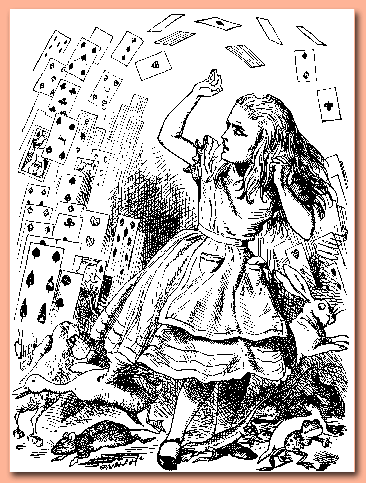
For interest: Read Alice in Wonderland and/or The Annotated Alice: The Definitive Edition ed. Martin Gardner. For more on Alice see here. In a way, Alice is a story that has achieved that *mythical* status - it has woven together mathematical principles, cultural ideas etc..."
What is digital culture? - Recap? (nb live blogged!)
We are looking beyond the IOCT to address the idea of forming a critical framework, judgements and to theorise one's own artistic work. That way we can demonstrate an understanding of what we're doing. When you come to do your final projects this kind of critical thinking will stand you in good stead.
Languages of New Media
Paul explains that there is always an element of interactivity with digital media. It's not necessarily true that there is a huge change when one moves on to a computer but there are degrees of interactivity.
Andy: well, everything is interactive.
Paul: sometimes it isn't important is someone interacts with something, what was important was the process...doesn't need an interactive purpose.
Jess: but as artist/creator you were interacting in the process of creation.
Andrew: so when artists create interactive installations is that a meaningless phrase or is there a point being made?
Paul: thinks this is about the intention rather than the meaning behind it. With all works of art and all systems of representation the user is required to fill in gaps in system (Manovich).
Andy: thinks interactive is being used to define degrees of control that the audience has
Andrew: so an interactive installation seems to imply that the audience has more control than a *usual* installation.
Jess: so does interactivity mean (for Paul) that the user can *change* the content
Paul: yes, to change the way it is deployed and navigated.
Andrew: If I build a pool, fill it and swim in it, how is that *experience* different from swimming in another pool?
Andy: to really originate something you must be the first person to make it (i.e. the wheel). But, innovation as a pure form and then innovation with constraints.
Paul: reminds us of Pierre Mendard and the context of the work
Andrew: If you have a sock and it gets a whole and you darn it and you keep darning it then over time you replace the thread...is it still the same sock? *infinite regress*
Solipsism: if a tree falls in the forest does it make a noise? This is the problem with postmodernism, the only way anything can be said to have a meaningful is if we all share that social reality but with postmodernism there is no social reality.
"... the sane, having at their disposal all the most deadly weapons of the postwar recovery; on the other, a seedy solipsist and fourpence. ..."
Murphy 82.
Paul: with musicians, though the music might not have been written by the performer it takes on a new meaning/context
Jess: thus gains some originality
Paul on Manovich: not only creating the things you want to create but that everyone who sees your work understands what you're trying to create.
Andrew: "intuition": discuss!
Andy: something you know without being told, people talking about interface design and what's intuitive for some people is not intuitive for others
Andrew: are there levels of intuition that exist apriori? (how birds know to migrate) With regard to elephant coming out of the wall, neuroscience is the most fertile ground right now for examining these things. There may be some kind of way of understanding what people know or want in a given situation.
Andy: But, if you put enough people in a room with a button and ask them what will happen one is BOUND to think an elephant will appear.
Andrew: how do we know intuition is intuition?
Andy: so there are cultural assumptions on what is intuitive.
Back to: Le Corbusier:
"If I hold up a primary cubic form, I release in each individual the same primary sensation of the cube; but if Iplace some black geometric spots on the cube, I immediately release in a civilised man an idea of dice to play with, and a whole series of associations which would follow. A Papuan would see only an ornament."
(1920)
What Le Corbusier was interested in were universal truths. There was a strong element of idealism here. And of course the consequences of this we see in Leicester with the *design* of the buildings.
But there is some interesting 60s design in Leicester:
""The Engineering Building comprises large ground-level workshops (heavy machinery), covering most of the available site, and a vertical ensemble consisting of office and laboratory towers, lecture theaters and lift and staircase shafts."
Photo, exterior overview · Engineering Building · Leicester University, Leicester, England
Andrew: So, is it possible to have pastiche that isn't hideous?
(this question stumped us for a while)
Andrew: Culturally we've been through a shift. Pastiche had been used as a valued way of people learning how to create art (music and painting). The idea was to be as close to the model as possible = good training. But, with Modernist aesthetic pastiche become loathesome and unoriginal. Replicating the trodden path. But now the keywords are innovation, creation, and originality. Emphasis on developing one's own voice.
Jess: Pastiche now is about challenging and questioning previous contexts.
Think of "The Band" and their song that incorporates a brass band segment.
Implies the user/reader has a more elevated status as they can understand this questioning/challenge.
Andrew: postmodern thought is largely affiliated with technology. The main point here seems to be "what is original, what is pastiche, what is contextualising." clearly very important for postmodern theory (think Lyotard).
Paul: Interesting point that knowledge loses its "use-value" so knowledge is tied to commercialisation. So, in web 2.0 are things that are supposed to be of use-value are actually about commerce?
"The nature of knowledge cannot survive unchanged within this context of general transformation. It can fit into the new channels, and become operational, only if learning is translated into quantities of information. We can predict that anything in the constituted body of knowledge that is not translatable in this way will be abandoned and that the direction of new research will be dictated by the possibility of its eventual results being translatable into computer language. The 'producers' and users of knowledge must now, and will have to, possess the means of translating into these languages whatever they want to invent or learn.”
Jess: but it seems that lyotard is combining two knowledges, that of creation and that of dissemination (form and content)
Paul: Going back to the idea of exchange having value but now it's the content that has value.
Andy: In open source the idea is that information has a value but not necessarily a monetary value. It has a value when shared not on it's own.
Andrew: Howard Rheingold sees the commons of information being privatised.
Jess: so commodified knowledge can live alongside knowledge for knowledge's sake.
Paul: maybe the future is downloadable music where people get the info as well as the experience
Andrew: voluntary contributions (Radiohead) is not the future. People are prepared to pay what they think is fair.
Andy: having music freely available is more like a promotional tack rather than a way of making money.
Andrew: So the live gig is the privileged commodity.
Andrew: What is postmodernism?
"plagiarism by anticipation"
Student Presentations on "Everything is Mediated"
Andy:
Paul: "Everything is Mediated"
Reading for Next Week:
Barthes, S/Z, A Barthes reader / edited, and with an introduction, by Susan Sontag A Derrida reader : between the blinds / edited, with an introduction and notes, by Peggy Kamuf.
(nb our discussion on Barthes and Wittgenstein was in the context of digital culture)
"... ce qui m'a toujours préoccupé [...] c'est le problème de la signification des objets culturels."
~Barthes, Mythologies 64
"Dans la vie quotidienne, j'éprouve pour tout ce que je vois et entends une sorte de curiosité, presque d'affectivité intellectuelle qui est de l'ordre du romanesque."
~Barthes, Mythologies 192
Like Barthes, we're interested in exploring and questioning the perceived *naturalness* or *objectivity* of culture (its objects and codes). We talked about Barthes view (in "Operation Margarine") of French bourgeois culture. Interpriting an ad for margarine Barthes finds negatives or problems associated with a product (like margarine) are raised in order for its benefits to be revered which then outweigh any cons. Barthes explains that this technique is mirrored in discourses of religion, capitalism, and war. To put it simply, drawbacks are noted only as a way of further demonstrating the crucial significance the object or discourse has for culture.
"The episode always begins with a cry of indignation against margarine: 'A mousse? Made with margarine? Unthinkable!' 'Margarine? Your uncle will be furious!' And then one's eyes are opened, one's conscience becomes more pliable, and margarine is a delicious food, tasty, digestible, economical, useful in all circumstances. The moral at the end is well known: 'Here you are, rid of a prejudice which cost you dearly!"
Here we debated what the word "world" means and whether there exists a *universal* understanding of "world" and does the term world include what lies outside of our perceptions?
For Wittgenstein a picture (any picture?) is a model of reality because the objects in the image relate to each other in the same way that objects in the world relate to each other. If the relations do not correspond, then the picture is not of something in the world. (But this can still be considered reality because the world includes the "non-existence" of things).
“Given that every object must occur in some state of affairs or other (2.0121), we know that given all states of affairs, all objects are given as well. But we have already seen that given the totality of objects, all possible states of affairs are given (2.0124). In other words, given all existing states of affairs, we can construct, by way of the objects they contain, all possible states of affairs — both those that exist and those that do not exist. It is in this way that the structure of reality is implicated in the structure of the world. For quite trivial reasons, the structure of the world is implicated in the structure of reality. Of course, it still remains a mistake to identify the world with reality, but, in the end, this is something that can be set right without undermining the basic principles of the Tractarian ontology.”
~~~R. J. Fogelin, Wittgenstein (Routledge & Kegan Paul, 1976) 12.
~~~~~
Talking about absolutism led us back to Barthes and his "Death of the Author." We talked about images and representations and the imbued coded meanings. We talked about context (that of the *original* author and that of the reader/author).
"We know that a text does not consist of a line of words, releasing a single “theological” meaning (the “message” of the Author-God), but is a space of many dimensions, in which are wedded and contested various kinds of writing, no one of which is original: the text is a tissue of citations, resulting from the thousand sources of culture. Like Bouvard and Pecuchet, those eternal copyists, both sublime and comical and whose profound absurdity precisely designates the truth of writing, the writer can only imitate a gesture forever anterior, never original."
We kept coming back to the question of authenticity of voice and of text.
While structuralist critics would see the text as deeply related to a real-life author. As Barthes notes:
"The image of literature to be found in ordinary culture is tyrannically centred on the author, his person, his life, his tastes, his passions, while criticism still consists for the most part in saying that Baudelaire's work is the failure of Baudelaire the man, Van Gogh's his madness, Tchaikovsky's his vice. The explanation of a work is awlays sought in the man or woman who produced it, as if it were always in the end, through the more or less transparent allegory of the fiction, the voice of a single person, the author 'confiding' in us."
For Barthes, texts are tissues of quotations, patchworks of others texts. Thus, there is no organised whole constructed by an authorial presence.
~~~~~
Task: After collecting evidence during our walk along the canal, create a multimodal response to the notion of "authorship" in a digital culture.
During this week's interesting discussion which seemed to keep coming back to literacy (what is it exactly), power, representation, and subjectivity I paused for a moment and captured a moment of "what really happened" as Barthes would have it: "the photographer had to be there ("The Photographic Image," Image/Music/Text 31)
This is me watching Professor Andrew Hugill watching his Second Life avatar watching a video...mise en abyme anyone?
"What is the content of the photographic message? What does the photograph transmit? By definition, the scene itself, the literal reality."
I jotted (on a laptop of course) as the discussion evolved:
Why is "aura" important to Benjamin?
Situate Benjamin within the climate in which he was working; modernist artists and composers were beginning to talk about defining aspects of the time including a look to the future, the importance of originality, universal concepts (grand narratives). One such believer in universality was Le Corbusier:
"If I hold up a primary cubic form, I release in each individual the same primary sensation of the cube; but if Iplace some black geometric spots on the cube, I immediately release in a civilised man an idea of dice to play with, and a whole series of associations which would follow. A Papuan would see only an ornament." (1920)
In other words, it seems Le Corbusier believes one can strip away cultural context in order to reveal only the surface meaning. This is, according to Le Corbusier because everyone "reads" primary forms in the same way.
~~~
Does abstraction imply a stripping away of cultural significance?
~~~
Without art in the world what would happen? Does art have a "utility" value? (Think of Malevich's Suprematist Composition: Red Square and Black Square)
This module gives an introduction to key ideas in critical and cultural theory that affect creative technologies and the creative industries.
The syllabus includes Modernism and Postmodernism, Structuralism and Poststructuralism, Feminism, Semiotics, Linguistic Theory, Anthropology, Rhizomes, The Work of Art in the Age of Mechanical Reproduction, Noise and Communication, Escience and Esocial science and The Ethnography of Cyberspace.