Showing posts with label critical theory. Show all posts

Monday, March 23, 2009

Lecture 11: Convergence, Globalisation and Digital Culture

Two of the videos we're going to discuss in the lecture today:

The World is Flat
Thomas L. Friedman


Marshall McLuhan - Explorations - 05-18-1960 - The World is a Global Village


For Next Week:

Blog post with audio:

"Is there a tendency to see the west as the origin/centre of globalization and the east as the *victim* that has been globalised (colonised)?"


Monday, March 9, 2009

Lecture 9: Feminism, Narrative & Web 2.0

Activity in Pairs:
To Review your Reading

With a partner add this to your blog post:
  • Explain two sections from Braidotti’s "Cyberfeminism with a Difference"
  • Critically analyse Braidotti’s thinking (in your two sections)
  • Define keywords which appear in your selections (such as postmodernity, post-human, irony)
  • Fill in the exploratree form: http://www.exploratree.org.uk/c/?x=car38191958u406egg (1 per group)
  • Include at least three links to resources that help explain or develop your interpretation (images/audio/video/reference)

Group One: Rachel and Andy P. - Introduction postmodernity
and Post-human bodies

Group Two: Max and Kieren - The politics of parody
The power of irony

Group Three: Amanda and Paul - Feminist visions on science fiction
The cyber imaginary


For Next Week:
  • Read: "Born Digital: A poet in the forefront of the field explores what is—and is not—electronic literature" by Stephanie Strickland, found here: http://www.poetryfoundation.org/journal/feature.html?id=182942
  • Bring a born digital example from your field of interest (online architecture, pedagogy, design, holography etc…)


Monday, March 2, 2009

Lecture 8: Introduction to Feminist Theory


Log into googledocs and complete the activity listed here: http://docs.google.com/Doc?id=dgfvwnr9_59dkcrr5f5


  • Key Theorist: Donna Haraway - her term "god-trick" for the idea that we can be objective, i.e. "see all from nowhere" but we've learnt that we're all situated, becoming subjectivities.
  • Donna Haraway, Luce Irigaray and Julia Kristeva develop the idea of “situated knowledge”: race, history, culture, gender, class, location all play important roles because knowledge is always constructed through who we are
  • Haraway: “the crucial political action that women and people of other marginalized groups must take is to 'refigure the terms of that story', to re-narrate, to 'produce a female symbolic where the practice of making meanings is in relationship to each other, where you're not simply inheriting the name of the father again and again.’”
  • Haraway's model = new forms of narrative do not simply subsume the old, but "widen the number and kinds of stories that get told and the actors who tell them."
  • “Cyborg writing" as a form of oppositional consciousness.
  • Critical literacy work is fundamental to critical engagement with larger structures of ideology & discourse, & to applying lived experience to an examination of relations of power
  • Situated knowledge is postmodern, i.e. remains resolutely dynamic


The links you'll need:

Rosi Braidotti's paper is here: http://www.let.uu.nl/womens_studies/rosi/cyberfem.htm

and I'd like you to choose one of the six born digital fictions from here: http://wetellstories.co.uk/

Any questions, remember to e-mail me: jlaccetti AT dmu.ac.uk

I'll look forward to reading your critical interpretations. Keep in mind these parts of the critical thinking process:


The image is from a presentation by University of British Columbia, Okanagan education professor Phil Balcaen. Have a read here for more information on critical thinking that adds to what we discussed in last week's lecture.


Saturday, February 28, 2009

Lecture 7: Critical Thinking, Maxine Armstrong

Weiss, D. (1994) Feminist Philosophy and the Digital Culture

Dr Dennis Weiss is a Professor at York College in Pennsylvania, who has published a number of articles, lectures and conferences presentations (Weiss, 2007). He currently teaches critical thinking and philosophy and wrote this text for his course in feminist philosophy.

It is relevant to our discussion on the critical thinking of feminist theory and digital cultures, as it uses feminist theories to explore digital cultures.

The first half of this text is referenced but the second half has none, so it is difficult to judge how valid his opinions are or where they come from. It is also 14 years old so digital culture has hopefully moved on in the meantime.


Booth, A. and Flanagan, M. (eds) (2002) Reload: Rethinking Women and Cyberculture, MIT Press.

A collection of critical essays and fiction exploring how women relate to virtual technologies, so again highly relevant to our discussions. It even includes an extract from Correspondence by Sue Thomas.

Only the introduction is reproduced on the Amazon website but it does introduces feminist science fiction, which is a genre I have never heard of. The index lists a number of people who could be investigated further.


Luesebrink, M.C. and Coverley M.D. (2000) The Progressive Dinner Party

A selection of hypertext and hypermedia literature works by women, written in English by international writers. The theme is a progressive dinner party inspired by the project The Dinner Party by Judy Chicargo. Each place setting is a contributor to the hypertext world with a link to a piece of their work, the Glenn Miller soundtrack does get a little annoying after a while. The website does not appear to have been updated recently as many of the links are broken, but it does still provide a useful list of women who are worth following. Sue Thomas, with Teri Hoskin, is one of the place settings with Noon Quilt. Commentary is provided by N. Katherine Hayles and Talan Memmott.

I would have liked to have seen this website updated with the links repaired and more recent work. The broken links and poor displays from some of the work shows how quickly technology had moved on.

Wednesday, February 25, 2009

Response from Professor Hugill: Music & Digital Cultures

Following on from his lecture on the 16th of Feb., Professor Hugill has taken the time to read your comments and is including a response. He addresses a variety of questions which stem from your own blog responses. Please read Professor Hugill's thoughts and respond to his question (via the comments on this post) which you'll find at the end of his letter.


"Dear Jess, Thank you for asking me to respond to the student comments following my lecture. I thought your post about the importance of critical thinking and logical argument was excellent. I'm ill in bed at the moment, so the brain is not firing on every cylinder, but on the other hand I have some time to write!

I agree very much with Mandy's comment that we covered a lot, maybe too much, in two hours, and of course none of the students has studied music, so somehow they had to rapidly assimilate both technical and aesthetic information about some of the most challenging music of the past 100 years. I thought they listened well - attentive and diligent and, given the content, relaxed, which was not always my experience when I covered similar ground with music students, who often became quite agitated.

Andy P. seems to have had the most extensive reaction and makes a number of points. I'll try to approach these in the spirit they are intended.


Let's tackle the 'definition of music' thing frst. Bear in mind that what we are seeking here is a definition. Definitions have pretensions to being objective, verifiable, and universal (applicable in all situations). In practice, there are many types of definition (see http://www.sfu.ca/philosophy/swartz/definitions.htm for example) but they all share that sense of rational aspiration to the absolute.

Music as 'organised sound' is not my definition but that of Edgard Varèse in his lecture/essay 'The Liberation of Sound'. He had very specific reasons for making the statement, arguing in favour of the inclusion of sounds not considered 'musical' in the traditional sense (i.e. not necessarily produced by instruments). No doubt this has inadequacies, but it *is* a definition. Notice he is not ascribing any particular value to the 'music' he defines. He is not attempting to say 'this is good music' or 'this is bad music'. He is trying to be factual and objective in order to expand our understanding of what music might be. The affective layer (such as emotional impact, aesthetic judgement, etc.) is largely put aside.


The word 'organised' is somewhat loaded. The first question we might ask is 'organised by whom'? Some might hear organisation in natural sound (which takes us into soundscape, which I had no time to mention in the lecture), but I think for Varèse the idea was that a piece of music is organised in the same way as a living organism - made up of many related elements. This suggests intentionality. One standard definition of a work of art is that it is evidence of an artistic intention (if an artist calls it art, it's art). In the postmodern world, we might also argue that it requires a suitable reception (people have to agree).


The point Andy P makes that music has no material existence is of course correct. Sound is a disturbance in a medium. I don't think Varèse is being materialistic, but I do think he is being scientific. Phenomena, such as electricity, may be observed empirically. Music is a perceptual phenomenon, certainly, but that does not necessarily mean it has only *emotional* existence. (Notice that the statement 'music is a perceptual phenomenon' is not a definition either, because it is incomplete).


Analysis of emotion is a vast field. Academic and scientific approaches range from the neuroscientific to the psychological. The one that seems to be causing the objection here is the James/Lange idea that emotion results from experiencing bodily changes, rather than causing them. There simply is neither time nor space (nor do I have the expertise!) to attempt to summarize these theories, but I think it is true to say that we still lack an accurate and consistent mapping of musical gesture to emotional response, probably due to social, cultural and individual variations. This is what makes emotion shifting ground from which to attempt a *definition* of anything. In what would an 'emotional definition' consist?


This is not a denial of the importance of emotion in music. It is simply a rejection of that as a basis for a definition. One person's 'emotive sound' is another person's 'indifferent noise'. I, for example, find some of Merzbow's 'noise music' emotionally affecting, whereas much pop music leaves me indifferent (which puts me in a minority). But I still think pop music is music. My opinion matters not if I am seeking to define 'music', but it matters a lot when I am choosing what to listen to! Perhaps an interesting variation on your question would be 'what is music *for* - something I tackle in my book.


One final point of accuracy - Cage's music was not 'unorganised'. It was organised using chance procedures. That may seem like splitting hairs, but chaos theory has shown us that there is organisation behind 'chance' and that randomness is predictable. On a historical note, 'organised sound' has stood the test of time as a definition and is still widely used. In fact, there is a journal published by Cambridge University Press under that very title and edited by Prof Leigh Landy, who heads the Music Technology and Innovation Research Centre here at DMU.


Turning to the discussion of serialism, let's have a crack at the statement:


"since it can be generated by a computer with no inspiration need at all and (at this time to me) sounds terrible, how can we say it is any different from what we would accept as patterned 'noise' from any other aesthetically unpleasing machine?"
There are a set of assumptions underpinning this which need to be challenged. The first is the rather 19th Century idea of 'inspiration'. In fact, much of the world's music is written without inspiration and is really the product of some kind of process or formula. Even those people who acknowledge inspiration are famously modest about its true value ("99% perspiration, 1% inspiration", said Thomas Edison, discussing the nature of genius). This is not to say the results of these formulae cannot be inspiring. Think of Javanese gamelan, for example. Or hymn tunes. But neither does inspiration guarantee good music. In fact there are many pieces that are highly inspired, yet unconvincing as music. Believe me, I've written some of them myself!

The next is the assumption that computers cannot write pleasing music. I wonder how much music written by computers people have actually heard? I don't mean music played off laptops, I mean music actually composed by computers. For early examples, try Xenakis, Koenig or the celebrated 'Iliac Suite' by Lejaren Hiller from 1957. For more recent examples (and these I am pretty certain will be found 'pleasing') try the many samples of fractal music, evolutionary music, generative music, algorithmic music, etc. that can be found online. Check out 'Changing Weights' by our own Dr Ron Herrema as an example
http://www.capstonerecords.org/CPS-8788.html

Finally, and this is what Varèse was arguing about, why is it necessarily the case that a machine produces 'noise'? If we accept that noise is unwanted sound (one can challenge that definition, by all means), then there are situations where machines do not produce noise, and sounds that are 'musical' might be considered noise. I think the perception of noise changes depending on circumstance.


It is true that total serialism was very well suited to computer composition, and in fact grew up alongside the development of early computers and dominated computer music. Perhaps the biggest figure in this field was Milton Babbitt, who is definitely worth a visit http://en.wikipedia.org/wiki/Milton_Babbitt

By the way, I'm not sure that additive synthesis is a good analogy for Steve Reich's phasing method in 'Come Out' and other pieces. Really, the crucial thing there is layering of sound and an audible process. It's a shame I had no time to play that piece - you really need to hear it to understand how it works. There is a copy in the library.


I could go on, but I feel the need of rest. Let's end with a question: what is the difference between a scientific experiment and a musical experiment? That should give people plenty to chew upon!"


Note, the image is
part of the score of Varèse's 'Poème Electronique' (1958).


Monday, February 23, 2009

Lecture 7: Critical Thinking and Essay Preparation


What is critical thinking?


“Reasonable reflective thinking that is focused on deciding what to believe or do”
-- Robert Ennis

“Active, presistent and careful consideration of any belief or supposed form of knowledge in the light of the grounds that support it and the further conclusion to which it tends”
-- JohnDewey


What is reflective thinking?

“Judgment suspended during further inquiry”
-- Dewey


Think of the scientific method as a way of organising your argument in your essay:

  • Definition of the problem
  • Proposal of the hypothesis/hypotheses
  • Observation
  • Measurement
  • Qualitative/Quantitative Analysis
  • Testing
  • Interpretation

An "ideal" critical thinker should employ these attributes:

  • Inquisitive
  • Open-minded
  • Orderly
  • Focused
  • Persistent
  • Devise testing strategies
  • Formulates alternative solutions/hypotheses
  • Judges acceptability of premises and inferences
  • Draws conclusions


Classic way *not* to structure your essay:


Syllogisms:

All X are Y. Z is X.
Therefore, Z is Y.

--or—

All X are Y. No Z is Y.
Therefore, no Z is X.

For next week: critically evaluate three websites/online resources that fit with feminist theory and digital cultures. Title your blog post: Lecture 7, Critical Thinking, Name.


Coursework Essay DUE DATE: 7th May, 4:00pm


Tuesday, February 3, 2009

Lecture 4: Reader Response Wordle Summary, Kieren Boddy

The Wordle tag cloud matched my interpretation to some extent through how highly I rated particular key words that stood out from reading the paper. Some of the words, although not used frequently, stood out from my interpretation of the context in which they where used. The words raised where 'conspiracy', 'Marxian', and 'rhetoric-police',whilst decreasing 'reading','writing' and 'professionalism', which were used frequently. 
My interpretation of the paper itself was that it was written by a person who is enthusiastic about the 'reader-response theory' and is dismayed by the 'grand conspiracy' against it by 'the elite' scholars who do not see the value of such a 'popular' theory such as the one she supports. 
Is there a conspiracy against the Reader-Response theory? I cannot tell from reading just this paper. I could tell that Harkin is entrenched into the idea that Reader-Response is the theory that should be taught more, but the way the paper was written makes me immediately question the validity of this through the way the point was argued for. 'Reader-Response' was described as populist in the 1970's and 1980's and was, and 'still is' shunned by the scholarly elite whilst those elitists hold up more newer or more established theories. I feel that it was more about 'apathy' than 'conspiracy' that lead to the decline of reader-response. A theory that was once made popular by an enthusiastic 'underclass' and its figureheads declined because of its figureheads dieing off and not being replaced and driving the benefits home. No matter what its benefits, a theory still needs proponents who voice them, in the case of 'Reader-Response', the proponents left seem at first reading, more desperate by siting 'Elitists', 'Conspiracy' and 'Marxism' to forward their views rather than just focusing on the benefits of such a theory. This then results in my views, although not fixed, of disregarding the paper with my own 'apathy' as I was not really won with the argument. 
I also would like to  agree with the points made by the previous blog posts by Paul and Rachel and the remarks they made about the theory and 'Common-Sense'.  
Wordle: Reader Response 

Monday, February 2, 2009

Lecture 4 - Reader Response

Due to severe weather conditions the lecture today is cancelled:


Please review the lecture presentation that has been uploaded to Blackboard (in both the course documents and learning materials sections) and complete the Wordle activity.


For your own "reading" assignment, choose ONE of the following:

http://www.telescopictext.com/ by Joe Davis
¨Inanimate Alice, Episode 2: Italy, by Kate Pullinger and Chris Joseph, www.inanimatealice.com
¨ii — in the white darkness: about [the fragility of] memory, by Reiner Strasser and M.D. Coverley, http://collection.eliterature.org/1/works/strasser_coverley__ii_in_the_white_darkness/index.html#top


***Reading for next week:***
“Différance” by Jacques Derrida
http://www.hydra.umn.edu/derrida/diff.html


Monday, January 26, 2009

student presentation: The Introduction to Structural Analysis of Narrative


by Amanda Moffat and Mandy Sellers

Lecture 3: Barthes and Borges - Student Presentations

As agreed last week, today we'll have three different groups present on three different texts.


Reading for next week:

Journal Cover
You can login to access this article via the jstory site using your athens login.

Tuesday, November 20, 2007

Lecture 8: Feminism and Cyberfeminism

Rosi Braidotti Nomadic Subjects
Luce Irigaray This Sex Which is Not One
Rosi Braidotti Cyberfeminism with a Difference


Irigaray

Paul: Irigaray seemed almost entirely about "dicks" and "vaginas."

Jess: it's about "bodies."

Andy: First chapter of Irigaray (on Alice) "skirts" the issue.


"Irigaray questions the assumption that female sexuality is dependent upon male sexuality. She asks and attempts to answer, such questions as, Where is female sexuality located if it always refers back to the penis? Where does female pleasure reside? What is female desire and what does it look like, if it looks like anything at all? And why does Freud insist that the penis is the only true sex organ?"


Homosexuality for Irigaray is not sexual but economic.

"Irigaray says that in this phallogocentric model, the kind of sexuality that gets privileged is one based on looking because the one sexual organ, the penis, is visible. So the Freudian model of sexuality, which privileges the penis, is based on the visual; it is scopophilic.

They (girls) notice the penis of a brother or playmate, strikingly visible and of large proportions, at once recognize it as the superior counterpart of their own small and inconspicuous organ, and from that time forward fall a victim to envy for the penis. (Sexuality and the Psychology of Love, "Anatomical Distinction Between the Sexes", pg.177.)

Male sexuality is based on having a penis, which is privileged because it can be seen; it is visible (and larger); therefore, it is superior. In contrast, a woman's sexual organ(s) cannot be seen; therefore it is inferior and becomes equated with having nothing. In other words, male sexuality is based on having a penis, female sexuality is based on having nothing. This system sets up the simple binary opposition of penis/nothing.

According to Freud, since women have nothing, women are always trying to get a penis for themselves in order to fill the lack: " A little girl . . . makes her judgment and her decision in a flash. She has seen it and knows that she is without it and wants to have it" (Ibid, pg. 177). Freud theorizes that women do one or a combination of the following three things in order to fulfill the desire to have a penis:

1. She will try to acquire the penis for herself by having a baby, especially a male baby.

But now the girl's libido slips into a new position by means - there is no other way of putting it - of the equation "penis=child." She gives up her wish for a penis and puts in place of it a wish for a child (Ibid, p. 180-81).

This desire has its roots in the Oedipus Complex, when the female child yearns to have a baby by her father to make up for her lack of a penis. This "wish" is repressed and redirected to having a baby with a man other than her father.

2. She will find or attempt to find a husband who is like her father, whom she believes is capable of giving it (the penis) to her. In fact, Freud believes that in certain cases newly married women "wish to castrate the young husband and keep his penis" (Ibid, p.72).

3. She will try to procure the masculine rights and privileges that the penis represents:

The hope of someday obtaining a penis in spite of everything and so of becoming like a man may persist to an incredibly late age and may become a motive for the strangest and otherwise unaccountable actions. Or again, a process may set in which might be described as a "denial," ....Thus a girl may refuse to accept the fact of being castrated, may harden herself in the conviction that she does possess a penis and may subsequently be compelled to behave as though she were a man. (Ibid, pg. 178)

According to Freud, if a woman acts like a man, i.e., rational, logic, etc, she is in essence denying the `fact of her castration' and is neurotic.

Therefore, according to Irigaray's reading of Freud, in the Freudian paradigm, female desire is always the desire for a penis to fill the lack or nothingness. Male desire, on the other hand, is to get back to the mother's body, to have sexual relations with his mother as is evidenced in the Oedipus complex. The result is that male and female desire look different; the female attempts to fill her desire by getting a penis, and the male attempts to fill his desire by having sex with a female other than his mother.


Braidotti

Nomadic Subjectivity:

Andy: it is not a migrant but a nomadic as the fact you are constantly going.

how about in a feminist framework:

Andy: you are doing something rather than trying to become an outward goal that we get there, it is an evolving thing.


"The practice of "as-if", for Braidotti, is a "technique of strategic re-location in order to rescue what we need of the past in order to trace paths of transformation of our lives here and now."(p.6) Braidotti also understands "as-if" as "the affirmation of fluid boundaries, a practice of the intervals, of the interfaces, and the interstices." While grounded in postmodernist theory of repetition, parody, pastiche, etc., Braidotti is insistent that for "as-if" to be useful, it must be grounded in deliberate agency and lived experience. Postmodern subversions and parody "can be politically empowering on the condition of being sustained by a critical consciousness that aims at engendering transformations and changes." (p.7)


What makes a pastiche useful?

Andy: changes contexts. And, that context is lived experience.

Paul: but we shouldn't just do something different but something better...

But, there are no value-judgements in pomo...


What's wrong with "identity?:

Paul - it's static
Andy - identity is defined by whats round you while nomadism is defined by what you are

""desire to leave behind the linear mode of intellectual thinking, the teleologically ordained style of argumentation that most of us have been trained to respect and emulate" (29)


Braidotti - Cyberfeminism

Paul: Braidotti is saying that the visual is purely a masculine preserve and the female way to interact with things is a more sensory/audio/feel/touch language rather than looking at things. Because looking at things objectifies things.

Andy: Science fiction is good as it allows for alternative perspectives

Paul: see ikon gallery's set up on the future using *trashy* sci-fi (planets of the apes future). For Braidotti it's a way of imagining other ways of looking at things

Andy: alternative views openes it up to alternative organisations and societies etc...

Andy: in sci-fi you get entirely female societies

Jess: Is a single gender society better then?

Paul: are there roles in society better performed by women?

Jess: argghhhhhhhhhh!!!!!

Paul: but there are lots of ways of being "male"

Andy: it comes down to being a person, not a gender.

Jess: what about "being"....how about "becoming."


"The central point remains: there is a credibility gap between the promises of Virtual Reality and cyberspace and the quality of what it delivers. It consequently seems to me that, in the short range, this new technological frontier will intensify the gender-gap and increase the polarisation between the sexes. We are back to the war metaphor, but its location is the real world, not the hyperspace of abstract masculinity. And its protagonists are no computer images, but the real social agents of postin dustrial urban landscapes.
The most effective strategy remains for women to use technology in order to disengage our collective imagination from the phallus and its accessory values: money, exclusion and domination, nationalism, iconic femininity and systematic violence."


Web 2.0 and Feminism

The web is platform.
Paul: people can change their identities etc... online, nothing is static.
Paul: there isn't a sense that the "now" has any sense of permanence.

Paul: is there an ideological stance in feminism today? Or is it universal?

Andy: a difference acknowledged today between everyone is the same and everyone is different.

Jess: Context is crucial.


Feminist Manifesto:

Paul: defining it as feminism is limiting

Jess: by why is it important today that we think about gender?


Andy:
(from blog post) "A "male" writer could be interpreted as "female" and vice versa. Writing without signifiers becomes androgynous. If all writing is androgynous and all users are reduced to text, then all users are androgynous. With a lack of signifiers, things other than gender can also be disregarded (age, race, etc)."


Andy: but gender isn't one or the other, so why don't we disregard it?

Andy: we exist on a gender spectrum.

Paul: "there is no gender spectrum."

Jess: but that implies there is a beginning and an end

Jess: read Judith Butler Gender Butler

Tuesday, November 6, 2007

Lecture 6: Review

Going back to the beginning

The critical thing about this course is the reading which follows the train of thought of the module. Going back to the name of the module (digital cultures) what happens when you put the two words together. What is culture - how might one define it?

Andy: Accumulated knowledge but not necessary everything that gets accumulated in history, because not everything makes it into being culture.

Andrew: Whose knowledge?

Andy: collective knowledge...

Andrew: Where is this knowledge and how do you access it?

Andy: books, a collective subconscious of things remembered

Andrew: so the surrounding culture shapes our identity, some kind of context for everything. This was one of the major conclusions from our first lecture, that everything has a context: people and artifacts.

The other word is digital?

Andy: A bland definition as compared to analogue, whereby digital works by a binary signal, on or off, 1 or 0.

Andrew: So a system of encoding? How do the 1s and 0s operate?

Task: get a simple definition of digital

Whereas culture is all about context, digital numbers don't really have a context.

FlatLand by Edwin Abbot a short novel.


Critical Reading Must: Pierre Menard by Borges and Walter Benjamin's The Work of Art in an Age of Mechanical Reproduction and Lev Manovich's The Language of New Media and try also Tractatus Logico Philosophicus by Wittgenstein. Here Wittgenstein is trying to describe the universe in words but decides that words just aren't adequate for some things (like God) so we can't talk about it. A very *pure* attempt to do the impossible.

Wittgenstein: Believed in scientific fact but is there such a thing as scientific fact? (Andy's question). See Richard Feynman.

"We can't define anything precisely. If we attempt to, we get into that paralysis of thought that comes to philosophers… one saying to the other: "you don't know what you are talking about!". The second one says: "what do you mean by talking? What do you mean by you? What do you mean by know?"
Volume I, 8-2


Think syllogism: "a deductive scheme of a formal argument consisting of a major and a minor premise and a conclusion (as in “every virtue is laudable; kindness is a virtue; therefore kindness is laudable."


Read Beckett's Murphy as there is a lot about the Modernist outlook. As Joyce said, Finnegan's Wake is not about something it is the something" - overall aim of the Modernist Project. Inspiration for musicians (John Cage, Barry Truax his riverrun, Roger Marsh).

Joyce, Vladimir Lenin and Tristan Tzara all in Zurich in 1917.

Barthes:
"ACCORDING TO ROLAND BARTHES, all narratives share structural features that each narrative weaves together in different ways. Despite the differences between individual narratives, any narrative employs a limited number of organizational structures (specifically, five of them) that affect our reading of texts. Rather than see this situation as limiting, however, Barthes argues that we should take this plurality of codes as an invitation to read a text in such a way as to bring out its multiple meanings and connotations. Rather than read a text for its linear plot (this happens, then this, then this), rather than be constrained by either genre or even temporal progression, Barthes argues for what he terms a "writerly" rather than a "readerly" approach to texts. According to Barthes, "the writerly text is ourselves writing, before the infinite play of the world (the world as function) is traversed, intersected, stopped, plasticized by some singular system (Ideology, Genus, Criticism) which reduces the plurality of entrances, the opening of networks, the infinity of languages" (5). This closing of the text happens as you read, as you make decisions about a work's genre and its ideological beliefs; however, when you analyze any one sentence of a work closely, it is possible to illustrate just how impacted with meaning (and possibility) any one sentence really is."


What is a myth? An anonymous story that attempts to explain a world view.

Derrida: does the author have any importance to a story?
"'there is no outside-the-text' signifies that one never accedes to a text without some relation to its contextual opening and that a context is not made up only of what is so trivially called a text, that is, the words of a book or the more or less biodegradable paper document in a library. If one does not understand this initial transformation of the concepts of text ...[and] ... context, one understands nothing about nothing of .... deconstruction ..."


"all those boundaries that form the running border of what used to be called a text, of what we once thought this word could identify, i.e. the supposed end and beginning of a work, the unity of a corpus, the title, the margins, the signatures, the referential realm outside the frame, and so forth. What has happened ... is a sort of overrun that spoils all these boundaries and divisions and forces us to extend the accredited concept, the dominant notion of a 'text' ... that is no longer a finished corpus of writing, some content enclosed in a book or its margins, but a differential network, a fabric of traces referring endlessly to something other than itself, to other differential traces."


TASK: Read!

Question: What is the culture of Wikipedia?


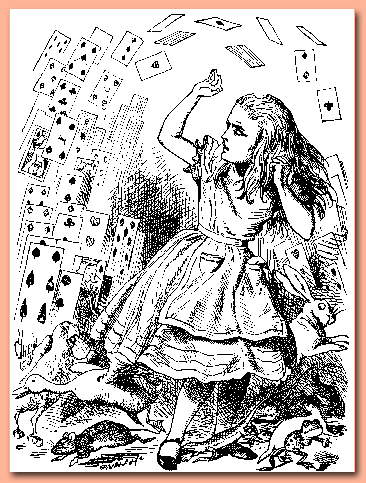
For interest: Read Alice in Wonderland and/or The Annotated Alice: The Definitive Edition ed. Martin Gardner. For more on Alice see here. In a way, Alice is a story that has achieved that *mythical* status - it has woven together mathematical principles, cultural ideas etc..."